What smart-city projects can learn from Smarte Region Würzburg

You are carrying a smart city or transformation project that is moving forward in substance. The measures are running. Partners are on board. And still you notice: hardly anyone outside the administration can say in one sentence what the whole thing stands for. Citizens stay outside. Participation does not come about. Your team loses time clarifying which name, which logo, which wording currently applies.
That is not a sign of poor work. It is a sign of growing complexity without orientation.
This text is not about sensors, data platforms or the next digital measure. It is about smart city communication in the narrower sense: how you make a system people understand out of many right pieces. How you order wild growth without pressing everything under a forced parent brand. And how you think from the start about what remains after the funding period. We write this from project experience. Not as general municipal consulting, but derived from a concrete undertaking: the Smarte Region Würzburg, in which city and district jointly entered the federal funding programme Modellprojekte Smart Cities. What you read here holds far beyond that. Würzburg is our example, not our unique selling point.
When the symptom is louder than the cause
The first reaction to confusion is almost always the same: we need a unified logo. A parent brand. A clear line. Everything under one roof.
Understandable. Wild growth costs time, nerves and trust. But unification is not automatically orientation. Sometimes it only flattens everything that would need to stay alive. The actual problem sits deeper. In transformation projects, complexity grows faster than clarity. Every new measure gets a name. Every audience a face of its own. Every funding phase a new sub-project. Inwardly that feels like progress. Outwardly like noise.
And noise reaches no one. Not the citizen who is meant to take part. Not the partner who could come along. Not the officer who at half past eight in the morning has to write an invitation and does not know which logo currently applies. Smart city communication rarely fails for lack of technology. It fails because no one understands what the whole thing is for.
Orientation instead of uniform
When we worked on the brand strategy for the Smarte Region Würzburg, the starting point was familiar: city and district jointly entered the federal funding programme Modellprojekte Smart Cities. The undertaking had grown. Many people involved, many offers, many good intentions. What was missing was a system that orders this variety without smothering it.
The task was not to press everything under a new parent brand. What was asked for was a brand architecture that can carry complexity. That is why we did not start with the logo. We started with a question: what should people on the ground actually experience? Not an abstract strategy project. But reliable, understandable offers that make a difference.
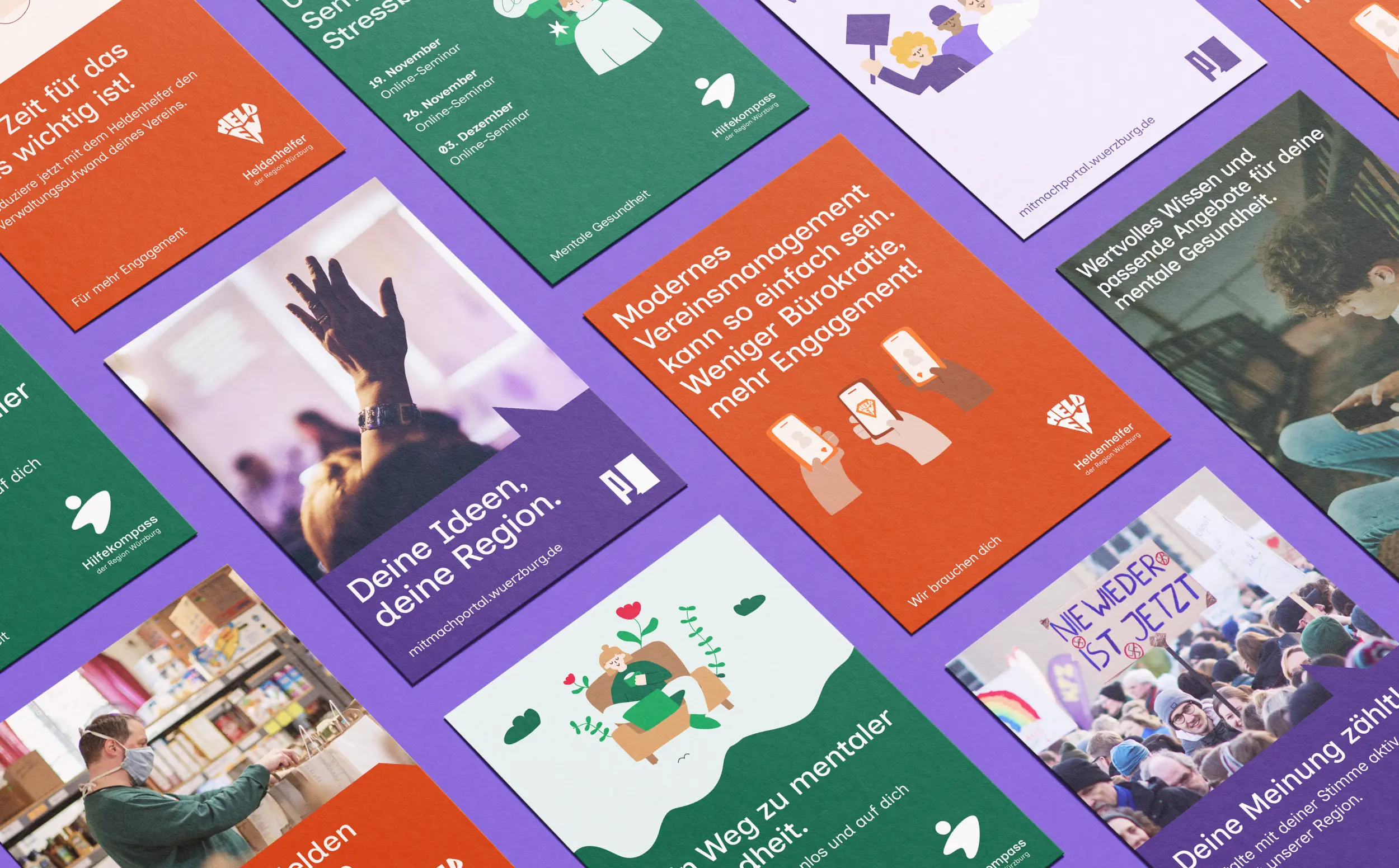
From that came a multi-brand system. No forced single brand, but a conscious construction: service brands with their own name, their own focus, their own visual identity. Each speaks directly to its audience. Each can exist beyond the funding period.
The time-limited project Smarte Region Würzburg stepped back as a bracket. In its place came the Region Würzburg. A parent brand that joins city and district and shows what they stand for together. Not as decoration over everything. But as a point of orientation in a system that lets what is independent stay independent.
Why a parent brand alone rarely suffices
The temptation is great to rationalise complexity away with a strong umbrella term. One name. One signet. Done. But transformation projects are rarely one-dimensional. They speak to different audiences. They join different carriers. They grow over years, not over a campaign.
If you force everything under one brand, one of two things often happens. Either the parent brand becomes so generic that it speaks to no one really. Or the individual offers lose their sharpness because they only still appear as a sub-item of a large story.
A good brand system does the opposite. It creates recognition without wiping out variety. It gives rules without smothering creativity. It orders without making everything the same. That is exactly what we mean when we speak of Form follows Narration. Design follows what is meant to be told. Not the other way around.
Thought as time-limited, built to last
One question we hear in municipal projects almost always. And it belongs at the beginning, not the end: what happens to the brand when the funding runs out? Many undertakings carry a project identity that disappears with the last funding euro. Not because no one thought of it. But because the brand was only ever thought for the project, not for what remains after.
For the Smarte Region Würzburg we therefore distinguished two levels. The project brand as a temporal bracket. And a regional parent brand thought beyond the model project. Service brands that can live on without the roof. A system that can be detached, instead of ending with the funding.
That is not a theoretical exercise. It is a question of substance. Time-limited money should not automatically produce time-limited effect.
Communication starts with the benefit, not the jargon
Technology rarely convinces on its own. That holds in the smart city too. Sensors, data, digital services. All of that can make sense. But if you have to explain what a citizen gets from it, and your sentence begins with synergies and transformation platforms, you have already lost.
Good smart city communication takes the undertaking out of administrative jargon. It starts with the concrete benefit on the ground. With the feeling that someone is understood. That an offer is reliable. That participation is not an empty word.
Participation does not fail for lack of interest. It fails because the invitation reaches no one. If people do not understand what they are meant to take part in, they stay outside. Not from disinterest. From a lack of orientation.
A system a small team can carry
Municipalities rarely work with large marketing departments. That is not a lack. It is reality. And that is exactly why a brand system has to work in everyday use, not only in the strategy presentation.
For the Smarte Region Würzburg we therefore set rules that an inter-municipal team can tend without ongoing accompaniment. One typeface. One grid. Recurring base elements. Clearly defined room to play. Not perfectionist. But consistent.
On top of that came a web-based brand manual that joins strategy and making. Templates for presentations and print. Guidelines for digital touchpoints. From considerations came tools that administration and partners can work with every day. A brand system is only good when it works without the studio that built it.
Questions worth asking before the next logo appears
If you are currently carrying a transformation project, an honest look is worth it. Not at the technology. At the orientation. Do your citizens know the undertaking? Or only your administration? Does your brand architecture carry beyond the funding period? Or does it end with it? Can you tend the system with your team in everyday use, without having to decide anew with every measure which logo applies?
And perhaps the most important question: are you currently trying to solve wild growth with a uniform? Or are you building a system that orders variety?
If you are deciding between unification and chaos, there is a third way. Not everything under one roof. But also not more of the same. Rather an architecture that shows what you stand for. And that lets people on the ground understand why it is worth coming along.
Not enough? Ask your AI about us